How to Size an Electric Sauna Heater (Without Oversizing It)
Size an electric sauna heater by room volume: about 1 kW per 1.3 m³, plus extra for glass and cold walls. A step-by-step guide with a sizing table.
The single most common mistake in a home sauna build is buying too much heater. It feels intuitive — more kilowatts, more heat, more safety margin. In practice an oversized stove blasts the air hot while the stones and benches stay cold, and you end up with a harsh, dry room that never produces a proper löyly. Sizing an electric heater is simple arithmetic once you know the room.
The short answer
Size an electric sauna heater by room volume: allow about 1 kW per 1.3 m³ of a well-insulated cabin, then add the equivalent of extra volume for glass, windows and uninsulated walls. A standard 2 × 2 × 2.1 m room (≈8.4 m³) needs roughly a 6 kW heater.
Step 1 — Measure the room volume
Measure the length, width and height of the sauna in metres and multiply them together. That figure — cubic metres — is the basis of everything.
A common home sauna of 2.0 × 2.0 × 2.1 m works out to 8.4 m³. Divide by the 1.3 m³-per-kW rule of thumb and you land near 6.5 kW, which rounds to the nearest standard 6 kW heater.
Manufacturers publish a rated room-size range for every model — for example “4.5 kW: 3–6 m³”. Use your volume to find the model whose range you sit comfortably inside, not at the very top edge.
Step 2 — Add for cold surfaces
The 1.3 m³-per-kW figure assumes fully insulated timber walls. Every surface that leaks heat — glass, a window, an exterior log wall — behaves like extra room to heat. Add the equivalent volume before you choose the model.
| Surface | Add to calculated volume |
|---|---|
| Glass door | +1.2 m³ |
| Large glass wall / panel | +1.5 m³ |
| Exterior window | +1.0 m³ |
| Uninsulated log or masonry wall | +1.5 m³ per wall |
So our 8.4 m³ room with a glass door becomes an effective 9.6 m³, which still sits comfortably in 6 kW territory but is now near the top of that band — a signal to confirm against the specific model’s range.
Step 3 — Match to a standard heater
Electric heaters come in standard steps. Use this as a quick reference for a well-insulated room, then confirm with the manufacturer:
| Effective room volume | Typical heater output |
|---|---|
| 4–6 m³ | 4.5 kW |
| 6–8 m³ | 6 kW |
| 8–10 m³ | 8 kW |
| 10–14 m³ | 9 kW |
| 14–18 m³ | 10.5 kW |
Why bigger isn’t better
Right-sized heater
- Soft, even löyly from fully heated stones
- Comfortable, layered heat from bench to ceiling
- Lower running cost and less wasted energy
- Thermostat cycles gently rather than slamming on and off
Oversized heater
- Harsh, dry air that feels sharp on the skin
- Stones never fully saturate, so steam is thin
- Trips its thermostat early and short-cycles
- Higher upfront and running costs for worse heat
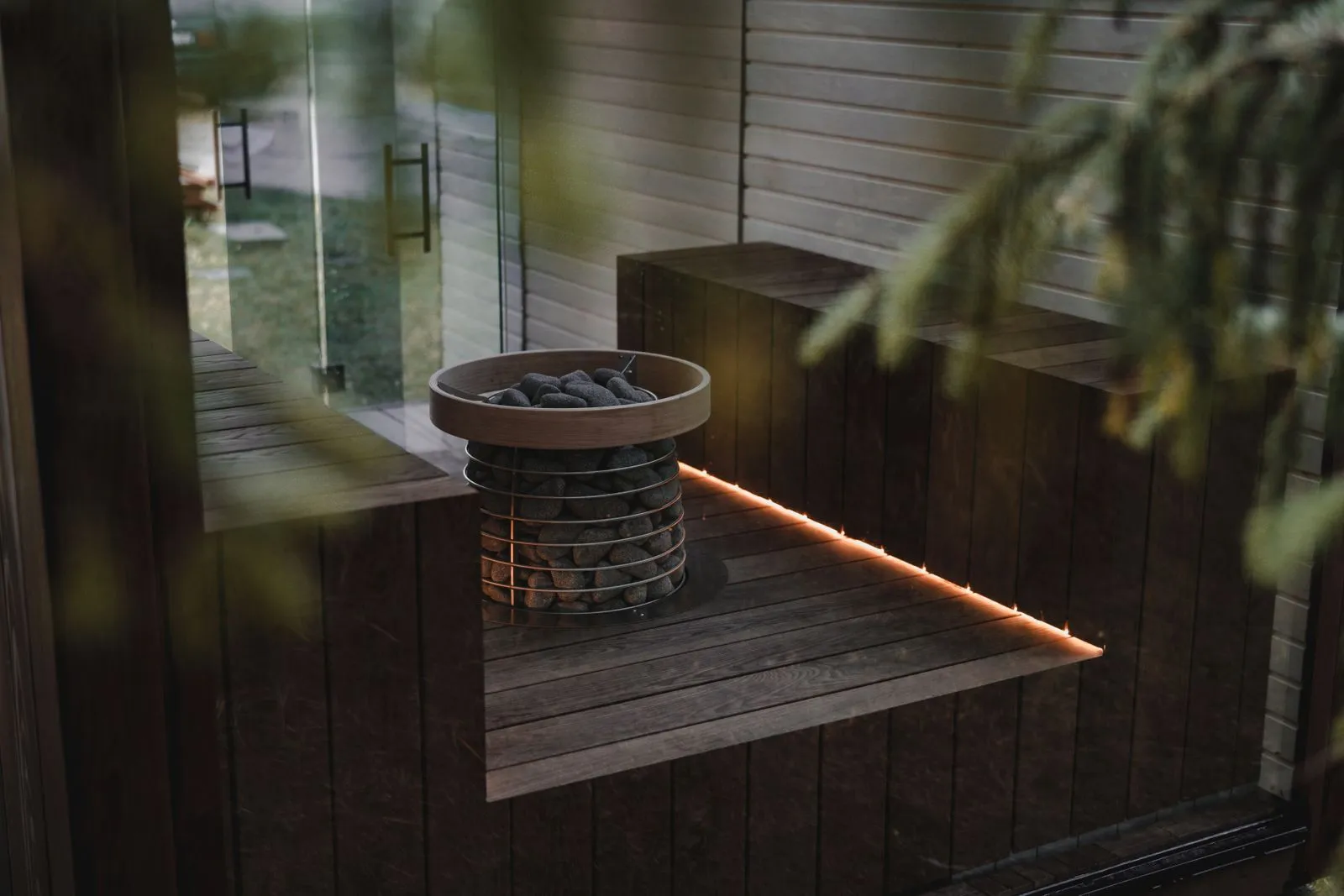
The stones — not raw wattage — carry the heat that makes a sauna feel good. A right-sized heater gives them time to soak up energy so that every ladle of water turns to steam. That’s also why the stones you choose and how you stack them matter as much as the kilowatt rating.
Wiring, breakers and safety
An electric sauna heater is a serious appliance. A 6 kW unit typically calls for a dedicated 240 V circuit in the region of 40 A, but the correct breaker size and wire gauge come from the manufacturer’s data plate and your local electrical code — in Canada, the Canadian Electrical Code. This is not DIY territory: heaters must be installed and connected by a licensed electrician, with correct clearances to the benches and walls. We go through the details in our heater installation and safety guide.
Practical buying advice
- Confirm the model’s room range rather than trusting a generic table — insulation quality varies.
- Prefer more stone capacity. Between two heaters of the same kW, the one that holds more stones usually gives softer, longer löyly.
- Check the control options. A separate wall control or an app timer is convenient, but adds cost and, for outdoor builds, wiring considerations.
- Think about heat-up time. If you’ll use the sauna spontaneously, a slightly quicker-heating model earns its keep; if you plan sessions, it matters less.
If your build is a backyard cabin or an off-grid cottage, it’s worth weighing an electric heater against a wood-burning stove before you commit — the two deliver quite different experiences, which we compare directly in electric vs. wood-burning heaters.
Get the arithmetic right and the rest falls into place: the right heater, fully heated stones, and a room that delivers a soft, controllable löyly every time — without the wasted energy of a heater that was never the right size to begin with.
Frequently asked questions
How many kW does my sauna heater need?
As a starting point, allow roughly 1 kW of heater output per 1.3 m³ of a well-insulated sauna room, then add capacity for glass, uninsulated log walls and windows. A typical 2 × 2 × 2.1 m cabin needs about a 6 kW heater.
What breaker and wiring does a 6 kW sauna heater need?
A 6 kW heater usually runs on a dedicated 240 V circuit around 40 A, but the exact breaker and wire gauge depend on the model and your local electrical code. Always follow the manufacturer's plate and have it wired by a licensed electrician.
Is it better to oversize a sauna heater to be safe?
No. An oversized heater blasts the air hot while the stones and benches stay cold, giving harsh, dry heat and poor löyly. Match the heater to the calculated room volume.
Can a sauna heater be too small?
Yes. An undersized heater never reaches temperature and runs constantly, driving up energy use without ever heating the stones properly. Size up only to the next standard model if you're between sizes.
Do glass doors change the heater size I need?
Yes. Glass and uninsulated surfaces lose heat, so you add the equivalent of extra room volume for each — roughly 1.2 m³ for a glass door and 1.0 m³ for an exterior window.
How long does an electric sauna heater take to heat up?
Most electric heaters bring a correctly sized room to temperature in 30–45 minutes. Wait for the full warm-up so the stones are hot before you add water.