Best Sauna Stones — and the Rocks That Will Crack
The best sauna stones are dense igneous rock like olivine diabase or peridotite. Here's what to buy, why ordinary rocks crack, and how much you need.
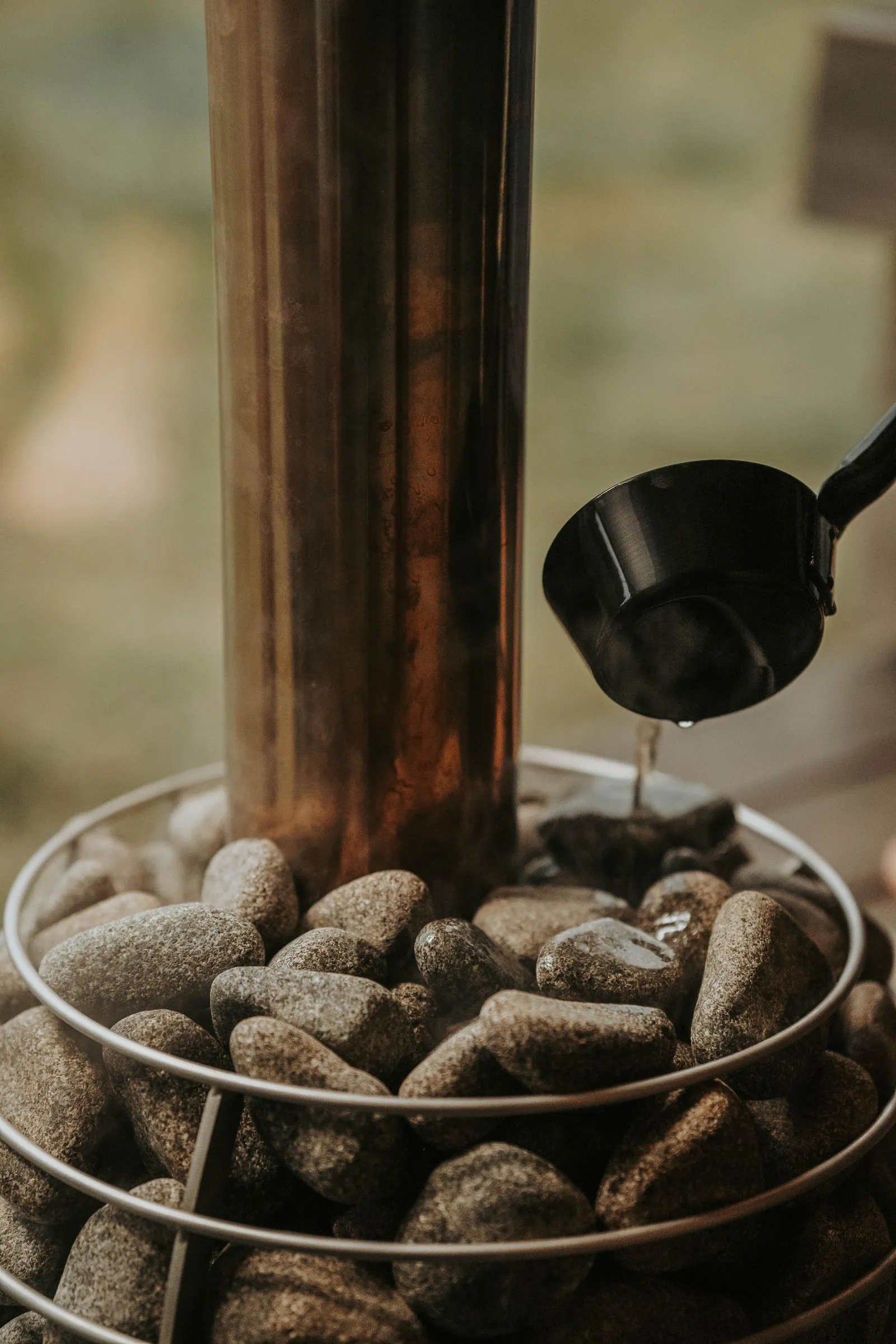
Sauna stones look like the most primitive part of the whole setup, and they’re often the most overlooked. But the stones are what turn a hot box into a sauna: they store the heat and they make the löyly. Choose the wrong rock and, at best, your steam is poor — at worst, a stone cracks or bursts in a hot, enclosed room.
The short answer
The best sauna stones are dense igneous rocks — olivine diabase is the most popular, along with peridotite and some basalts — bought specifically for sauna use. Avoid sedimentary rock and random river stones, which can trap water and crack or explode when heated.
What makes a good sauna stone
A sauna stone is heated to several hundred degrees, doused with water, and cooled — over and over. A good stone survives that cycle for years. The qualities that matter:
- Density and hardness. Dense igneous rock stores lots of heat and resists thermal shock.
- Low porosity. Water trapped inside a porous stone turns to steam and can split it. Non-porous rock is safe.
- Even mineral structure. Uniform stone expands evenly; layered or mixed stone stresses and cracks.
- A rough surface. Slightly textured stones grip water and vaporise it better than smooth, polished ones.
| Stone | Suitability | Notes |
|---|---|---|
| Olivine diabase | Excellent | The standard sauna stone; durable, great heat retention |
| Peridotite | Excellent | Dense, heavy, long-lasting |
| Basalt (dense) | Good | Works well if genuinely non-porous |
| Vulcanite / ceramic | Good | Engineered options with consistent performance |
| Granite | Risky | Can contain quartz that fractures with heat cycling |
| Limestone / sandstone | Avoid | Sedimentary, porous — crack and degrade |
| River / landscape rock | Avoid | Unknown composition; may trap water and burst |
How many stones, and what size
Fill your heater to the capacity the manufacturer specifies — not more, which can obstruct airflow and, on electric heaters, trap heat around the elements. Capacities vary widely: a compact electric unit might take 10–20 kg, a big wood stove 40 kg or more.
Size matters too. A mix is ideal: larger stones (roughly fist-sized) lower down for thermal mass and to keep air moving, smaller stones toward the top where the water actually lands. All-tiny piles choke airflow; all-huge piles make coarse, splashy steam.
Loading them correctly
Stones are stacked loosely, not packed, so hot air and — on electric heaters — the elements can breathe. We cover the method, including how to lay them around electric elements, in how to stack and replace sauna stones. The short version: rinse them, place the biggest at the bottom, and leave gaps so air and steam move freely.
When to replace them
Stones don’t last forever. Each heat-and-douse cycle stresses them, and over months they develop cracks and shed grit. Inspect the pile once or twice a year:
- Replace any stone that’s visibly cracked, crumbling, or has split.
- Restack the pile at the same time, since stones settle and shift.
- Expect a 1–3 year life for regular use; heavy use shortens it.
Crumbled stone dust packs into the pile, chokes airflow, and dulls the löyly — so refreshing the stones is one of the cheapest upgrades to an aging sauna.
Good stones are inexpensive and they make a disproportionate difference. Buy the right rock, load it properly, and keep an eye on it, and the heart of your sauna — the steam — will stay soft and strong for years.
Frequently asked questions
What are the best stones for a sauna?
Dense igneous rocks that handle repeated heating and cooling without cracking — olivine diabase (the most popular), peridotite and some basalts. Buy stones sold specifically for saunas rather than picking rocks yourself.
Why can't I use ordinary rocks in a sauna?
Many common rocks hold pockets of water or minerals that expand when heated, so they can crack or even burst. Sedimentary stones like limestone and sandstone, and river rocks, are especially risky.
How often should I replace sauna stones?
Inspect them once or twice a year. Replace stones that are cracked or crumbling — typically every 1–3 years for a regularly used sauna, sooner for a heavily used one.
How many kilograms of stones does a sauna heater hold?
It depends entirely on the heater; small electric units hold 10–20 kg, while large wood stoves hold 40 kg or more. Fill to the capacity the manufacturer specifies — no more.
Should sauna stones be washed before use?
Yes. Rinse new stones to remove dust and grit before loading them, so the first löyly isn't full of fine debris and the airflow through the pile stays clean.
Do bigger or smaller stones make better löyly?
A mix works best: larger stones at the bottom for thermal mass and airflow, smaller ones toward the top where water lands. Uniformly tiny stones choke airflow; uniformly huge ones store heat but make coarse steam.